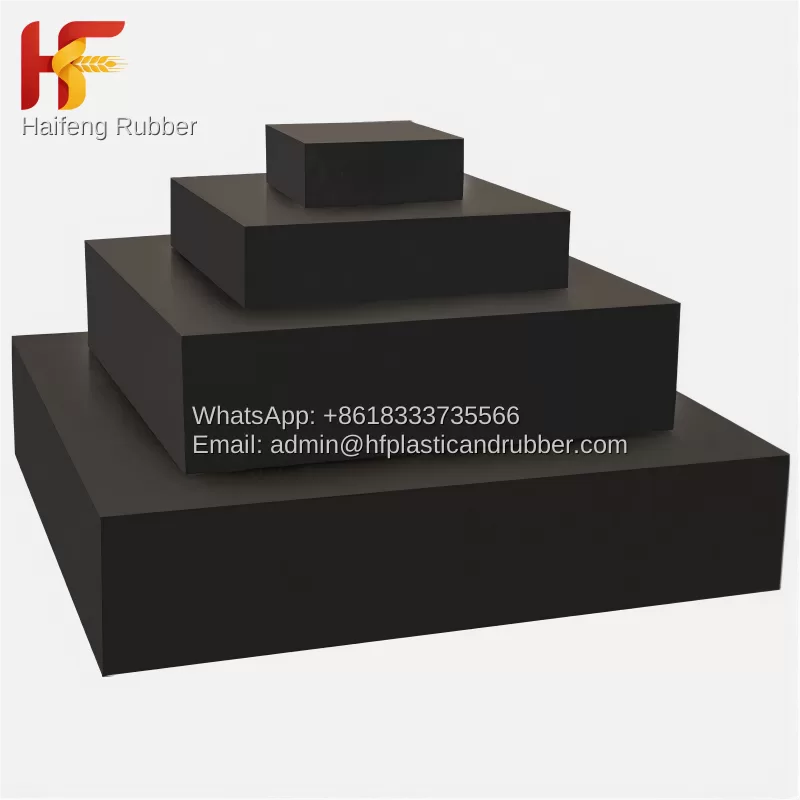
Product Overview
A rubber vibration isolation block deforms under load and helps separate vibrating equipment from its supporting structure. Performance depends on static load, excitation frequency, block geometry, rubber hardness and installation arrangement.
A softer or thicker block is not automatically better. If the block is overloaded, under-compressed or operated near resonance, isolation performance can be poor even when the rubber itself is durable.
Haifeng Rubber supplies plain blocks, drilled pads and molded rubber-to-metal parts after load and dimensional review.
This product is an engineering component. Final sizing should be based on load, deflection and operating frequency rather than dimensions alone.
Key Features
- Elastic rubber construction for impact and vibration control
- Hardness and geometry selected against working load
- Plain, drilled and rubber-to-metal designs
- NR, CR, EPDM and NBR compounds available by environment
- Prototype and production molding
- Custom inserts, plates and mounting holes
Applications
- Pumps, compressors and fans
- Industrial machinery bases
- Generators and HVAC equipment
- Conveyor and material-handling equipment
- Dock, buffer and impact stops
- Equipment feet and protective support pads
Specifications
| Thickness | custom |
|---|---|
| Width | custom |
| Length | custom |
| Hardness | custom |
| Color | custom |
| Density | custom |
Customization Available
These options can be adjusted after the required application and order specification are confirmed.
- Block size and profile
- Rubber hardness
- Studs, plates or threaded inserts
- Static load and target deflection
- Oil-, weather- or heat-resistant compound
- Part marking and packaging
Frequently Asked Questions
How do I select a vibration isolation block?
Provide the equipment weight, number of support points, operating speed or frequency, mounting space and environment.
Does harder rubber isolate vibration better?
Not necessarily. Hardness must match the load and required deflection. A block that is too stiff may transmit more vibration.
Can metal plates be bonded to the rubber?
Yes. Steel plates, studs or threaded inserts can be bonded during molding when the design requires positive mounting.
Which compound is suitable around oil?
An NBR grade may be considered for compatible mineral oils, while the exact oil and temperature still require review.
Can you guarantee a load rating?
A load rating requires a defined geometry, compound and test method. It cannot be assigned to rubber blocks in general.
Can Haifeng Rubber provide custom sizes and cut parts?
Yes. Provide the required dimensions, tolerances, quantity and drawing so the suitable manufacturing method can be reviewed.
What information should be included in an enquiry?
State the application, operating environment, required properties, dimensions, quantity, applicable test method and documentation needs.